Echo sounders
are the most popular equipment
that uses sound waves and are often used in fisheries
and recreational fishing. An echo sounder explores the sea by utilizing the
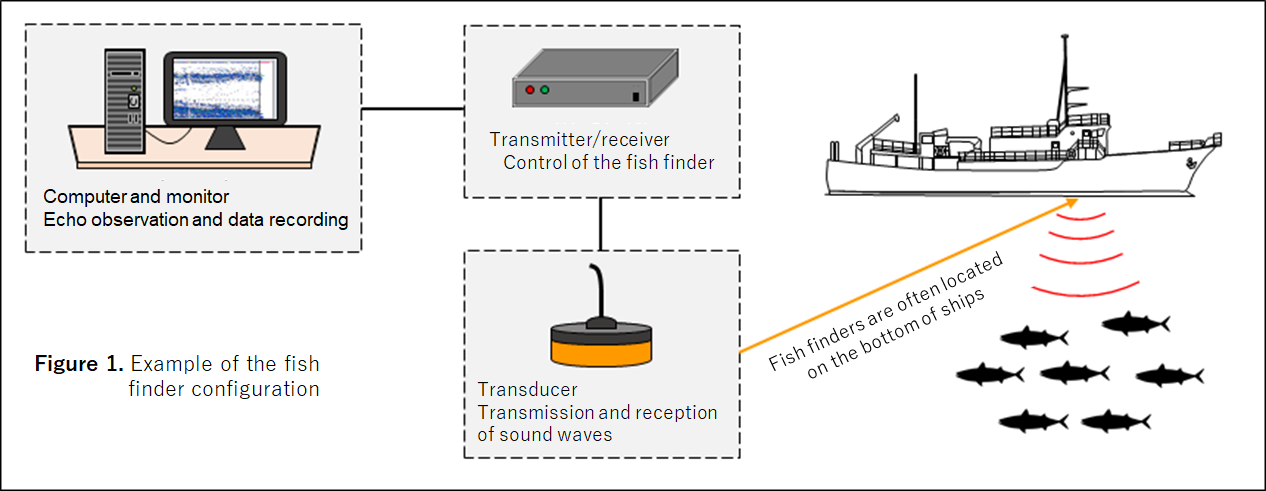
property of sound waves that “reflect when they hit an object .” The echo sounder comprises a transmitter/receiver, a control unit, and a
transducer that functions as both a microphone and speaker (Figure 1).
Principle (pulse‐echo technique)
An echo sounder is
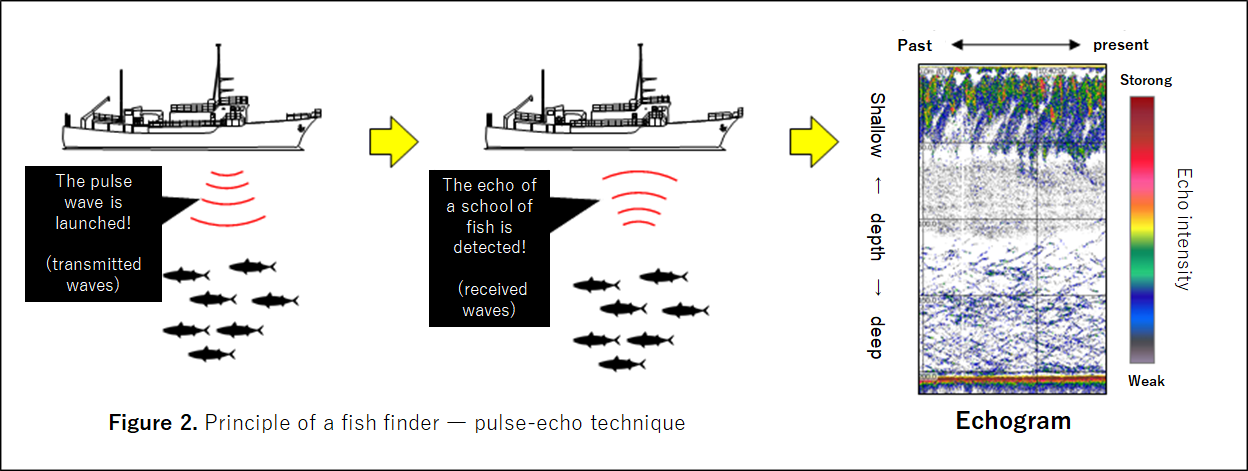
a device that detects an object located directly under a ship by the pulse‐echo
technique. As shown in Figure 2, a transducer attached
to the ship's bottom first transmits sound waves directly under the ship
(wave transmission). This is a short sound wave of approximately 1/1000 second, called a pulse wave (a sound like a hand-clapping). After hitting an
object in the sea, a part of the transmitted sound wave is reflected, and
returns to the original path called an echo. The object located directly
under the ship can be observed by detecting (receiving) this echo with the
transducer, and this is the same principle as the so-called “Yamabiko”. If the time from the transmission of the
sound wave to the echo's return is measured, its product with the speed of
sound (sound velocity) is the distance between the transducer and the object that
the sound wave reciprocates (distance = velocity x time). In addition, because the strength
of reflecting sound waves differs depending on the properties of
the object they hit (number, size, and constituent substances), the strength of
the echo can also be used to identify the object. The distance and strength
of the echo are expressed in the echogram, which allows visual observation of
the number of organisms in the ocean and the depth they are located.
The sound
waves generally used in fish finders are ultrasonic waves with a high
frequency (20 kHz or higher) that cannot be heard by the human ear. Because the
echo intensity varies even for the same object depending on the frequency, the
types of organisms in the ocean can be estimated based on the difference in the
appearance on the echogram by using various frequencies at the same time.
Since echoes
return not only from organisms but also from the seabed, the water depth under
the ship can be measured. Therefore, fish finders are also used as depth
sounders.
Quantitative echo sounder ~high-performance
fish finder for scientists!~
It is intuitively
thought that there are many fish when a strong echo is obtained. In
other words, the strength and weakness of this echo can be considered as a clue
for estimating the number of fish in the ocean. The fish finders used by
researchers can quantitatively express the strength of this echo (the strength can be
expressed numerically) and are called “quantitative” echo sounders. Therefore,
the number of marine organism resources can be efficiently estimated using a quantitative echo sounder.
Estimating the number of resources with a quantitative echo sounder
A quantitative echo sounder expresses the echo intensity by the volume
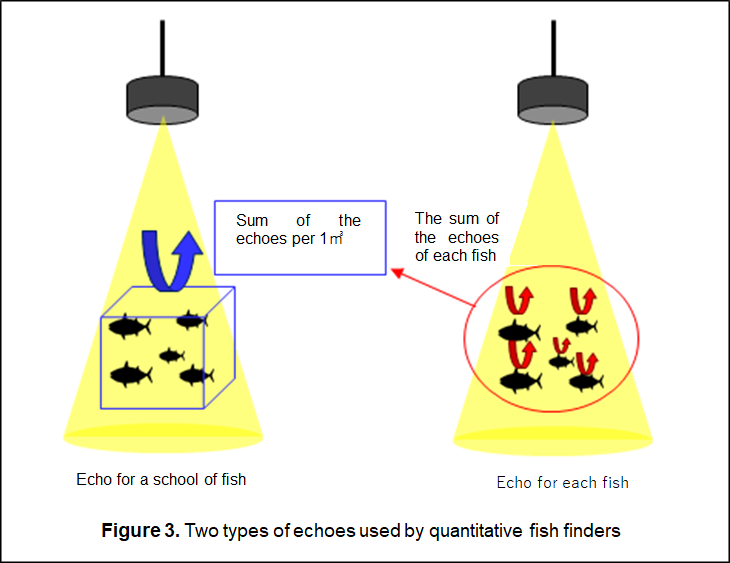
backscattering strength (SV) value. The SV is
the sum of all echoes bounced off an object within the range with a volume of 1 m3.
For example, two fish per 1 m3 are
indicated by the echo strength of two fish, and five fish per 1 m3 are
indicated by the echo strength of five fish (Figure 3).
In such a
situation, what if the average echo strength per fish is known? Assuming that the
SV represents the echo strength for a certain number of fish, if we divide
it by the strength of the echo per fish…
the echo strength per cubic meters / the echo strength per fish = n
Yes, this
answer n represents how many fish per 1 m3 (the resource density (fish/m3)). Multiplying
this density by the surveyed volume gives the number of fish in the
entire surveyed area, and this is the concept of estimation of the amount of
resources using a quantitative echo sounder. The echo strength per fish mentioned
earlier is called the target strength (TS), and its value
is very important for estimating the amount of resources using a quantitative echo sounder. Therefore, investigating the TS for each species is also one of
the main subjects in this research field.