

Results of investigating seafloor sediments ~Facing the mystery of iodoethane~
섹션 개요
-
-
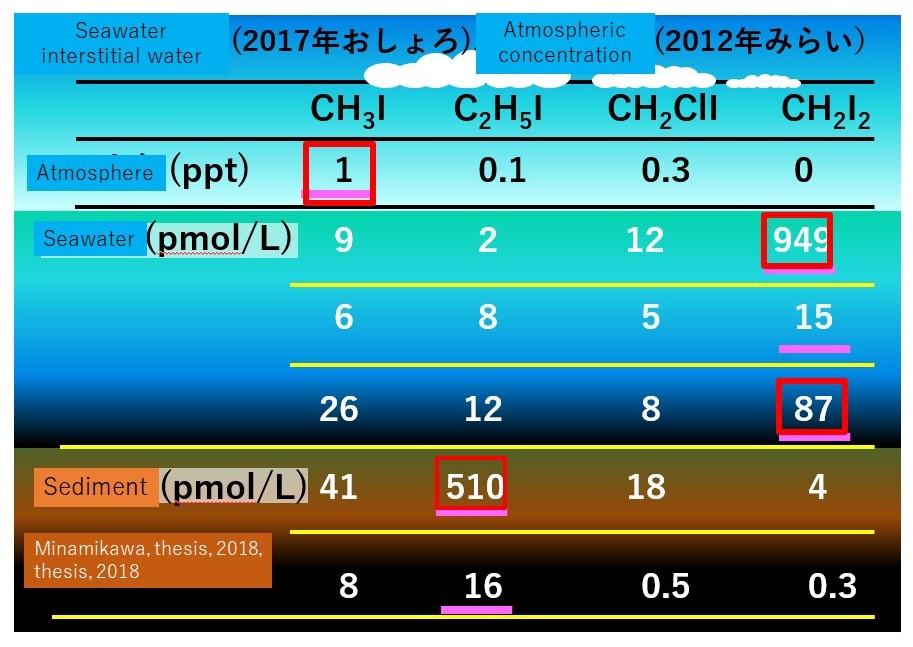
Ocean sediments in the coastal area were collected at the Arctic Ocean (Chukchi Sea) and Funka Bay, and interstitial water (pore water) on the surface of the sediments (layers in contact with seawater) was collected. The organic iodine gas species concentrations in the pore water were then measured with GC-MS system. We have firstly known the concentrations of organic iodine gas components in the atmosphere, seawater, and sediments. Their averages are summarized in the table below.
Iodomethane (CH3I) is a major component (component shown on left in the table below) of the atmosphere. This is because it exists in a relatively stable state in the atmosphere. It can also be a major component of seawater. Diiodo-methane (CH2I2) can also become a major component in seawater (the reason remains a mystery). Iodoethane is always a minor component in both the atmosphere and seawater (second component on the left in the table below). We discovered that iodoethane was always a predominantly major component in the sediment. This is a mystery of the iodine cycle. We are currently trying to determine the underlying reason by conducting experiments in which organic matter deposited on the sediment layers is cultured. in order to solve this mystery.
-
We collected phytoplankton using a NORPAC net during the diatom bloom in Funka Bay.
We are confirming iodoethane generation by decomposing and culturing diatom organic matter. We observed that the amount suddenly increased approximately three days later.
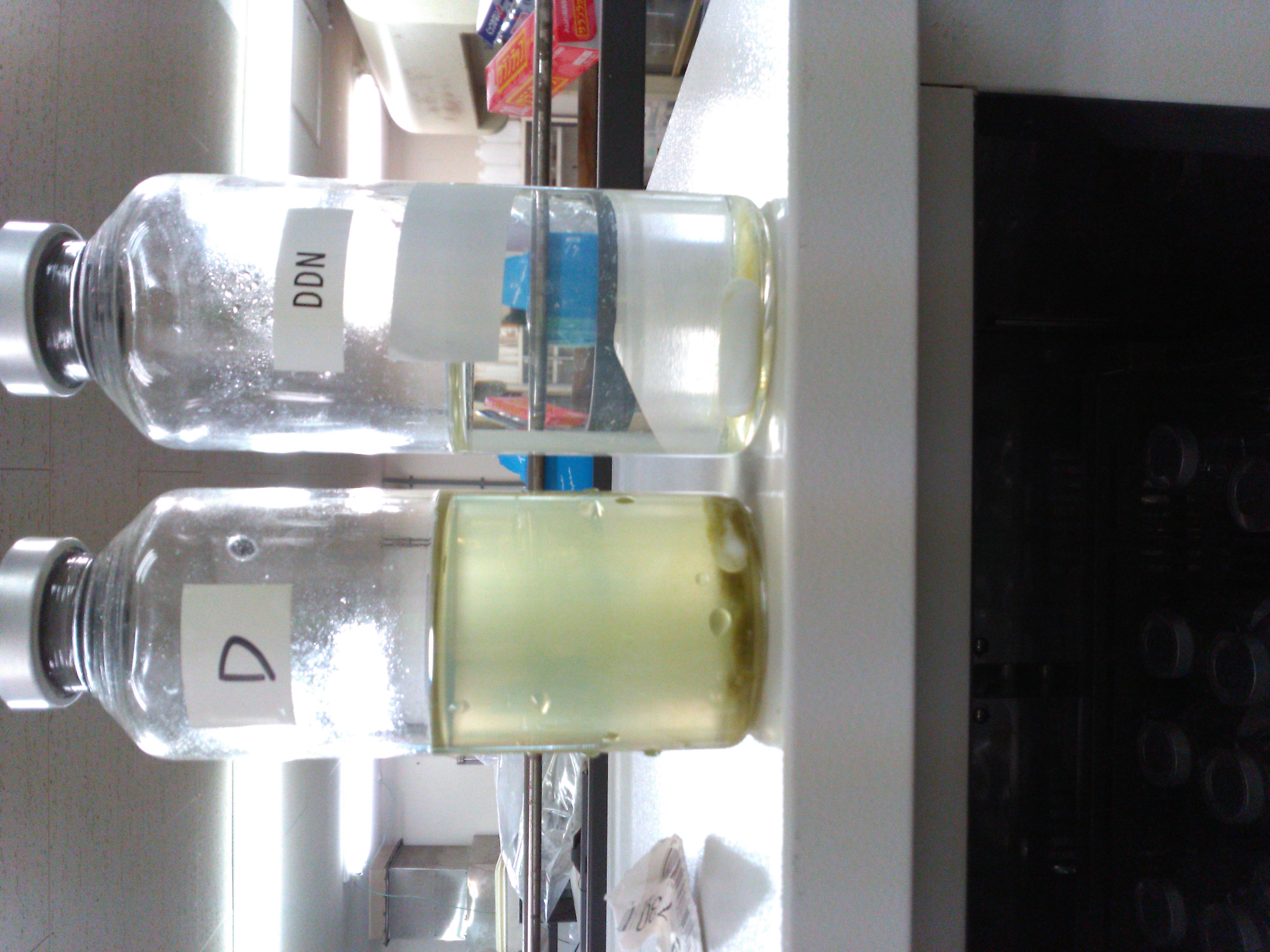
(Second-year master’s student Meng is conducting experiments)
-
This is a video taken when seabed sediments were collected during multiple-core observations on the Oshoro-Maru. Please take a look.
-