

Identifying the direction from which sound comes
Section outline
-
-
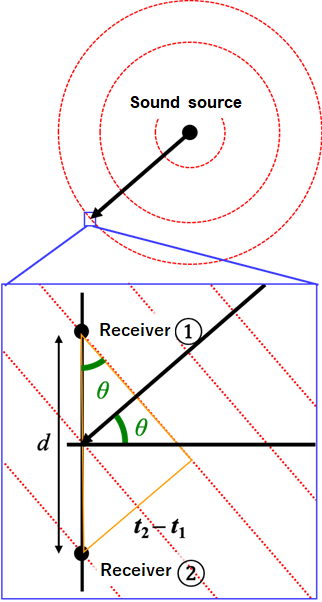
Identifying the direction from which sound comes involves the use of an apparatus (receiver) that receives multiple sounds. When two receivers are installed as shown in the figure, the time for each receiver to receive a sound differs depending on the direction from which the sound comes. This difference in the time (t2 - t1) and direction of the sound arrival (θ) can be expressed as
 using the
installation interval (d) between receiver ① and receiver ②.
using the
installation interval (d) between receiver ① and receiver ②.Since there are two values of θ that satisfy this condition, the direction of sound arrival can be determined by installing two additional receivers and measuring the difference in time.
-