

Amplification of northward heat transport in the Bering Strait by solar heating
섹션 개요
-
-
The volume of Pacific Water flowing northward in the Bering Strait is increasing, with an annual average of 0.7 ×10⁶ m3 s-1 in 2001 and 1.2 ×10⁶ m3 s-1 in 2014 (Woodgate, PiO, 2018), and the northward heat flux through the Bering Strait is also increasing (the purple line in the figure below). This increase in the northward heat flux is thought to result in reduced sea ice in the Chukchi Sea, promoting solar heating. Therefore, we calculated the cumulative solar heating throughout the Chukchi Sea from May to September between 1999 and 2015, and found its increasing trend (the red line in the figure below).
Solar heating integrated over the Chukchi Sea in summer varied interannually from 3.6 × 10²⁰ J in 2000 to 6.7 × 10²⁰ J in 2015, and was up to twice the northward heat flux through the Bering Strait. The total heating in the Chukchi Sea implies that the heat in the Chukchi Sea provided by northward heat flux through the Bering Strait is amplified by solar heating in the Chukchi Sea. We further compared these heat fluxes into the Chukchi Sea with the summertime northward heat flux through Barrow Canyon, an indicator of heat flux from the Chukchi Sea to the Arctic basin (no figure). The northward heat flux through Barrow Canyon was affected by the interannual variation of solar heating in the eastern Chukchi Sea. These results imply that modification of Pacific water in the Chukchi Sea by solar heating plays an important role in the interannual variation in heat transport from the Chukchi Sea to the western Arctic basin.
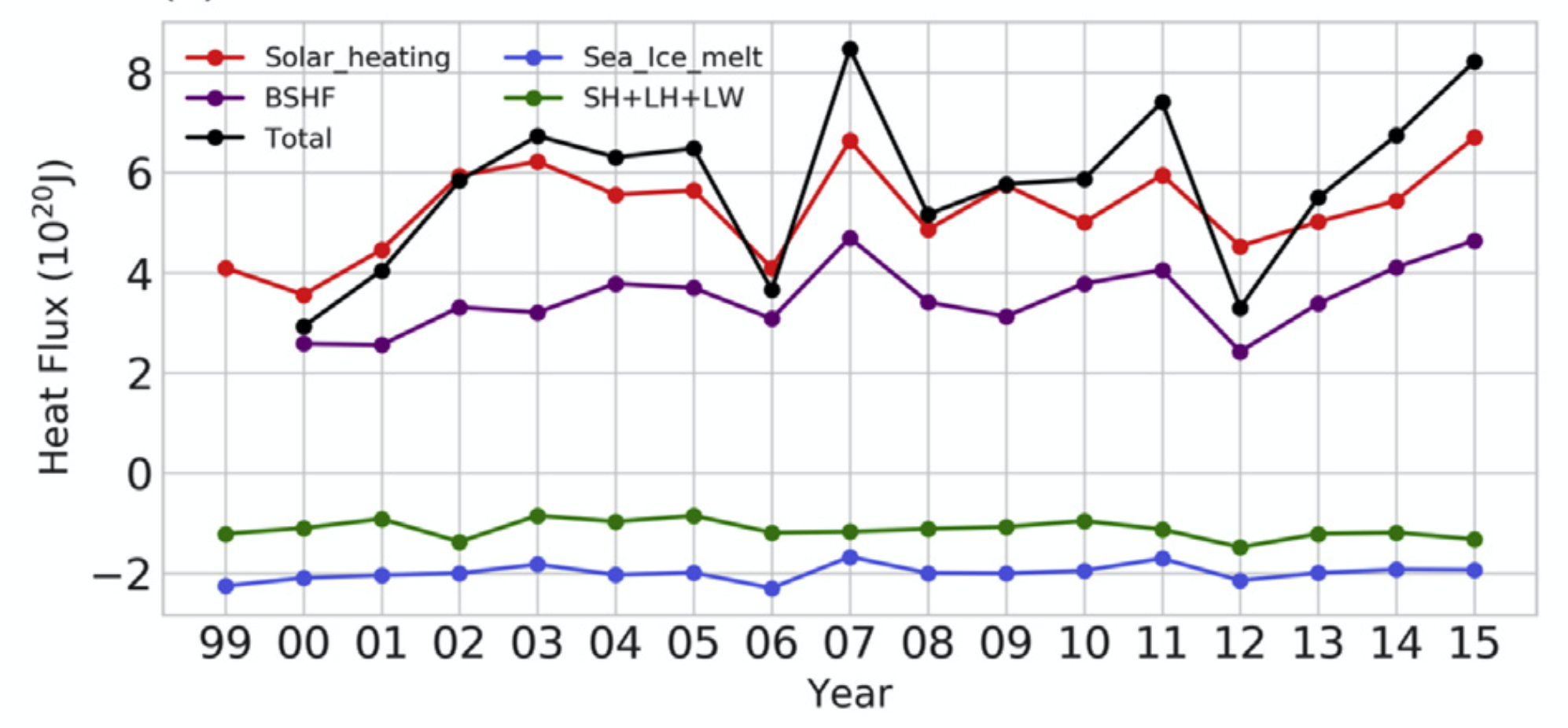
Interannual variation in solar heating (red), total heating (black), sea-ice melting heat (blue), and the sum of the sensible heat (SH), latent heat (LH) and longwave radiation (LW) fluxes (green) integrated in the Chukchi Sea from May to September (1020 J). Purple line indicates northward heat flux through the Bering Strait (BSHF) integrated from May to September. Modified figure from Tsukada, Ueno et al. Polar Science (2018).
-