

Making fibrils from the swim bladder collagen of sturgeons
セクションアウトライン
-
-
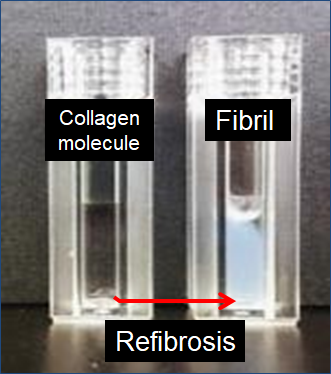
Collagen from the swim bladder of sturgeons exhibits special properties that are different from mammalian collagen. The extracted collagen molecules dissolve well in an acidic solution (left), but when neutralized with a buffer solution, they form fibrils and become cloudy and white (right).
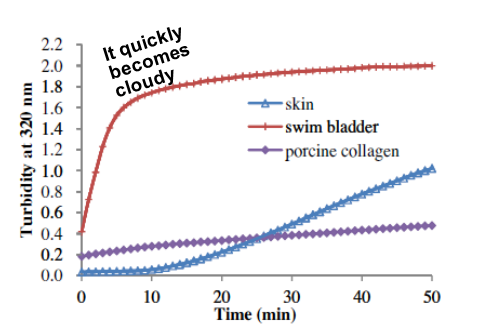
This graph shows the change in the cloudiness measured with a spectrophotometer. As you can see, the swim bladder collagen (red line) becomes cloudy more quickly (= fibril formation progresses) than the porcine collagen (purple line).
Zhang et al., 2014, Food Chemistry
-
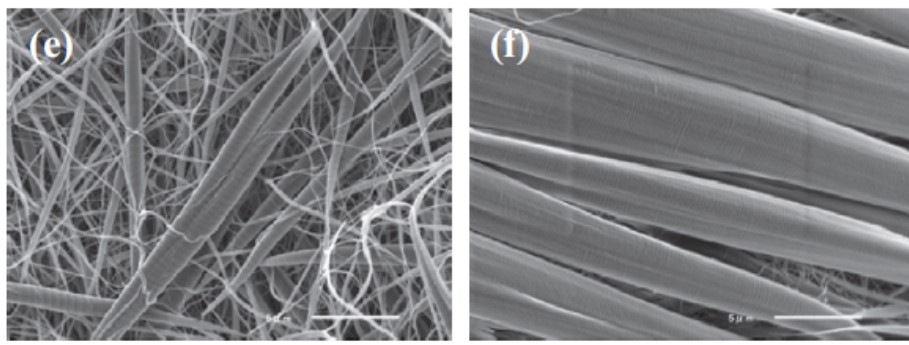
These are scanning electron micrographs of the fibrils prepared as mentioned above. As you can see, fibers of various thicknesses are formed. Porcine collagen can only make much finer fibrils. When used as cell scaffolds, it is highly advantageous for collagen fibrils to be able to quickly produce various forms. This is because cells can recognize the thickness and orientation of the collagen fibrils in scaffolds and react in various ways. If the thickness and orientation of the collagen fibrils of the swim bladder can be controlled, it may be possible to control the proliferation and differentiation of cells.
-