

The evolutionary lineage of organisms
セクションアウトライン
-
-
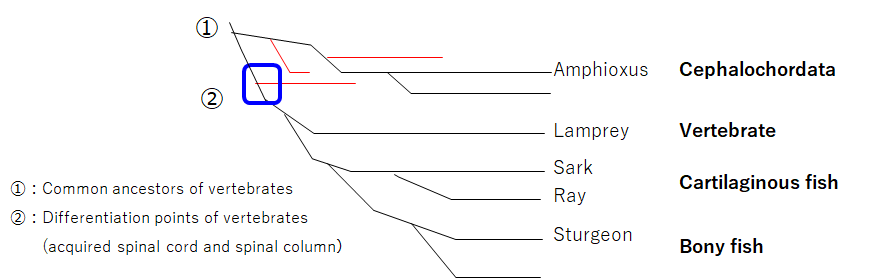
Here, we consider the evolutionary lineage of vertebrates. The spine is the organ through which the spinal cord and notochord pass in the spinal column bone, and lamprey is considered to be the most primitive vertebrate. However, it does not have the same vertebrate ancestor as the existing hagfish, and a vertebrae-bearing animal (an ancestor of the vertebrates), which does not exist today, is thought to have been born somewhere in the evolutionary history, differentiating into lamprey and other vertebrates. To find out whether lamprey is a species close to the common ancestor of the vertebrates (whether it has reached the present without much differentiation), it is presumed to be closer to its ancestral species if it has more points of agreement than existing related invertebrate species (for example, Amphioxus of Cephalochordata). Methods of comparing the characteristics of body morphology as well as DNA have been used for this purpose. The remaining lamprey-like biological fossils will provide important evidence for exploring common ancestors and periods of differentiation, allowing us to trace how it differentiated from its ancestral species to the present species.
-
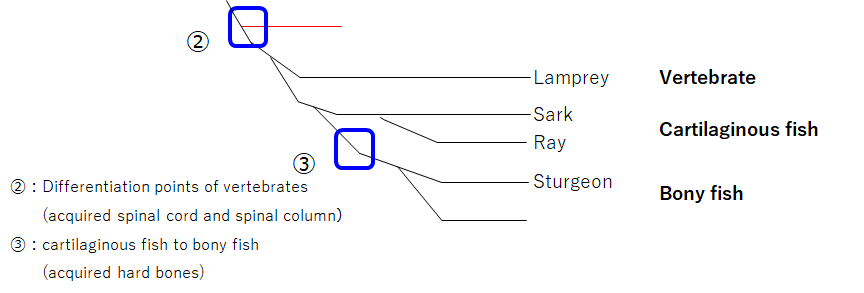
The bones of primitive vertebrates were cartilage. The existing cartilaginous fishes, including sharks and rays, have differentiated into ○× as they retained cartilage. Bones have been calcified (calcium phosphate) somewhere in the evolutionary history of vertebrates to evolve into those organisms with hard bones (③). From there, the diversity of vertebrates to this day was born. At what point did these differentiations occur? I would like to give a time axis. The most direct evidence comes from fossil records. However, fossil records are often recorded only in special places and at special times, such as when there is the sudden accumulation of volcanic deposits in a certain place. Thus, sufficient evidence cannot be obtained in most cases. There is also a method in which the number of differentiations is calculated by DNA analysis and the time required for it is estimated (molecular clock). The period of differentiation is inferred by combining multiple pieces of circumstantial evidence.
-