However, after the death of a large number of fish due to disease,
surviving individuals may have genes for disease resistance. Regenerating such
individuals and establishing their strains are important tasks in fish breeding.
However, this requires the generation of a gamete from the surviving
individuals, and I would have to say it is difficult to obtain a gamete from an
individual who survived the disease. Thus, can we produce the first stage of a germ-line,
which is the PGC, from the somatic cells of such individuals?
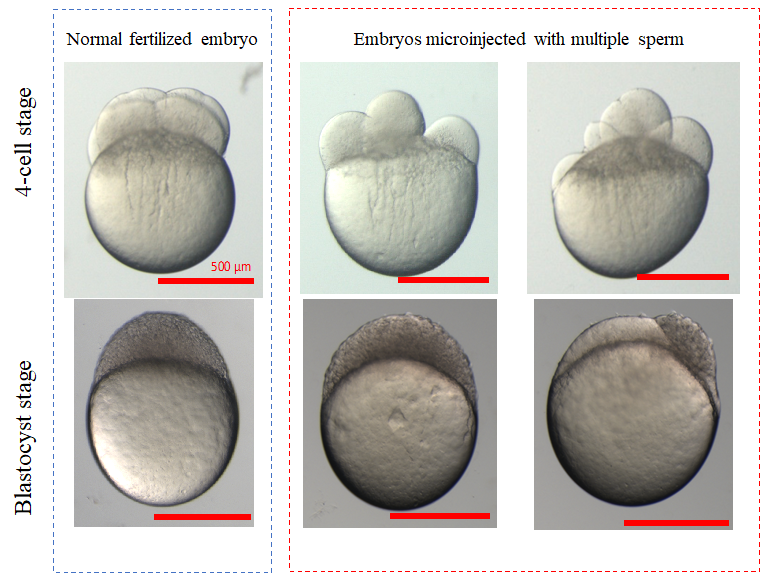
In fish, the microinjection of many sperms into one egg induces
embryonic development, although at a low rate. Then, can we isolate a PGC from
this embryo? Figure 13 shows the external morphology of an embryo that emerged
from an egg in which a large amount of sperm had been microinjected into an
unfertilized egg. It has become clear that this embryo also has blastomeres
with germ cytoplasm. Therefore, we are working on extracting such blastomeres
and inducing germ-line chimera in our research.