單元大綱

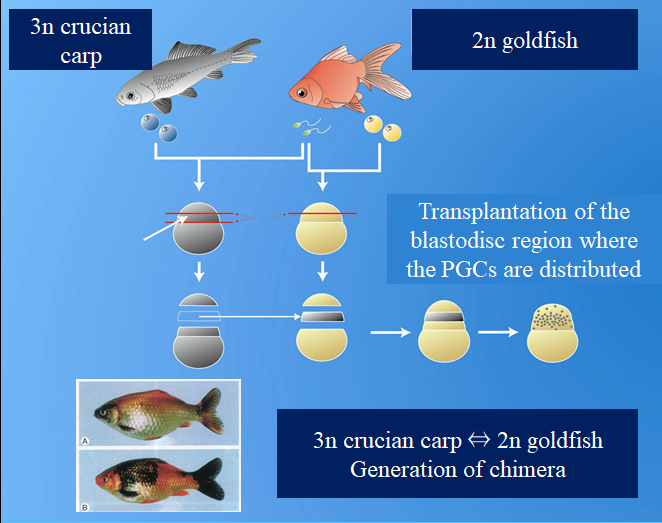
    •  A chimera is defined as an organism in which the cells generated from multiple fertilized eggs form an individual. In other words, they are individuals in which the cells of one fertilized egg are transplanted into another fertilized egg, including the one in which the blastodisc is transplanted into another blastocyst as shown above. Among the chimeras, an individual in which the somatic line cells are composed of cells derived from multiple fertilized eggs is called a “somatic cell chimera,” while an individual in which the germ-line cells are composed of cells derived from multiple fertilized eggs is called “germ-line chimera.”

    • Germ-line chimera

      Because the blastocyst cells of fishes are pluripotent, the transplantation of cells from other embryos can induce chimeras. In such a case, the transplantation of germ-line cells produces not only a germ-line chimera but also a somatic cell chimera. Thus, as shown in Figure 10, the transplantation of the blastodisc of the crucian carp into the blastodisc of the goldfish produces a chimera with both goldfish and crucian carp cells, which lays both goldfish and crucian carp eggs. Therefore, it produces an individual fish that lays two types of eggs.

      In addition, as shown in the differentiation of germ-line cells, fluorescent PGCs can be produced by microinjecting artificial mRNA into a fertilized egg. The transplantation of these germ cells into other embryos can induce germ-line chimera as shown in Figure 11.

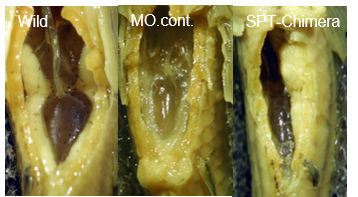
      Furthermore, a gonad can be formed even from a single PGC when one PGC is transplanted from a donor after blocking the production of PGCs in the host (Figure 12.


    • Figure 10. Transplantation of a crucian carp embryo into a goldfish embryo produces a “chimeric individual” with red and black pigments. This individual lays both goldfish and crucian carp eggs. Therefore, it is not only a germ-line chimera but also a somatic cell chimera. PGC: primordial germ cell.


    • Figure 11. A germ-line chimeric individual in which only fluorescent germ cells were transplanted. Fluorescent germ cells autonomously migrate to the gonads in the transplanted individual.


    • Figure 12From left: a gonad of an untreated control individual (Wild), a gonad of acontrol individual whose primordial germ cell (PGC) production was blocked (MO.cont), and a gonad of the individual in which a PGC was transplanted to another individual whose PGC production was blocked (SPT-chimera). A pair of developed gonads were found in the Wild individual, but not in MO.cont. Furthermore, only one gonad was developed in the SPT-chimera.