

Larvae
章节大纲
-
-
Japanese eel larvae were born in the middle of the tropical sea, approximately 3 mm in size.
They have long yolk sac and oil droplet under their body.
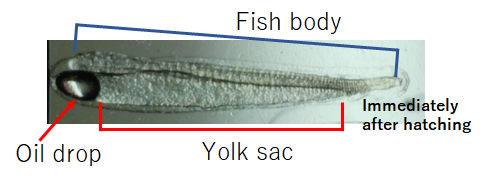
Yolk sacs and oil droplets are the only “food” they can take until the larvae start the first feeding.
-
The yolk and oil droplet are consumed in approximately one week after hatching, similar timing of the first feeding (exogenous consumption).
The eels before and after the first feeding are called preleptocephalus and leptocephalus, respectively.
The preleptocephalus and leptocephalus eels are collectively called larvae.
Japanese eels spend approximately half a year in the sea during the larval stage.
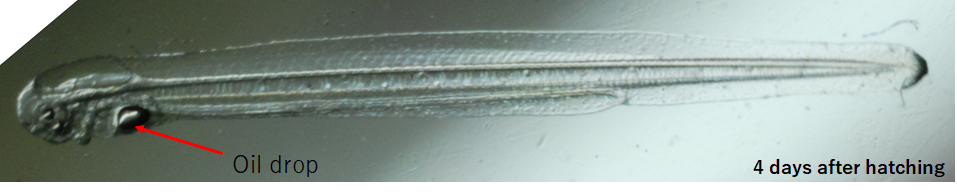
The timing to define the preleptocephalus and leptocephalus period differs depending on the scholar.
Some use the general concept of early and late larval stages, thereby using the absorption of the egg yolk and oil droplet and the start of feeding as the criteria (approximately one week after hatching), while others call the eels preleptocephalus until they exhibit a leaf-like shape, which is unique to leptocephalus larvae (approximately one month after hatching).

To avoid confusion, I prefer using the term “larvae” without separating the two.
-
Among the mysterious life history of eels, the larval stage has been a mystery for many years.
To begin with, their larvae are never found in the river because they spend the larval stage in the sea.
Even if they are caught in the sea, who can even imagine they are eels?
Larvae have a completely different shape from the adult eels, don’t they?
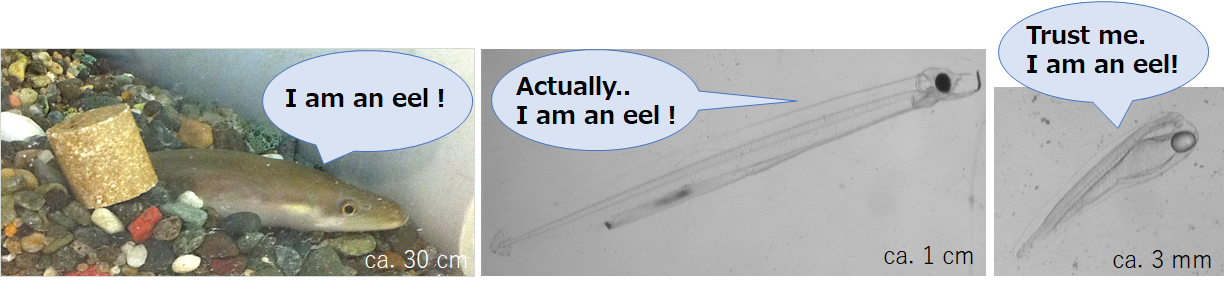
Aristotle, an ancient Greek scholar who tried to find the eel larvae but failed, said, “Eels are born in the mud.”
With the advancement in molecular biology techniques, genetic assessments of species found these interestingly shaped creatures to be eel larvae.
-