

Background
セクションアウトライン
-
-
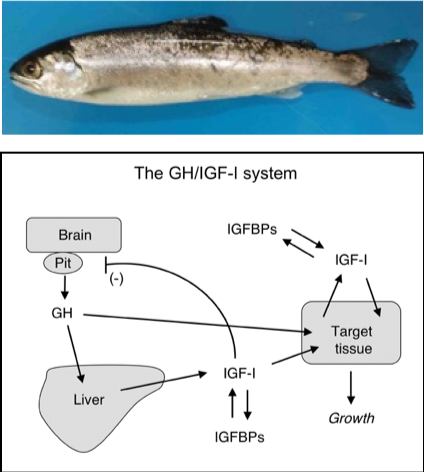
Growth of fish is influenced by various environmental factors such as photoperiod, water temperature, feeding ration and stress. Such stimuli are integrated by the brain and hormones regulate growth. Growth hormone (GH) and insulin-like growth factor (IGF)-I are two major hormones regulating growth. GH stimulate growth directly acting on target tissues such as muscle and bone or indirectly through stimulating hepatic production of IGF-I. This system is called “the GH-IGF-I system”. Circulating IGF-I mediates action of GH and has a negative feedback effect on the secretion of GH from the pituitary gland.
Most circulating IGF-I is bound to one of six IGF-binding proteins (IGFBPs). IGFBPs can inhibit or stimulate the activity of IGF-I depending on the type, post-translational modification and microenvironment. Thus, IGFBPs play a key role in modulating growth. Teleosts have up to 12 IGFBP subtypes due to the third-round whole genome duplication in this lineage. In addition, salmonids are tetraploid origin and thus have 22 subtypes.
Goal: We are interested in unraveling functions of IGF-I and IGFBPs in salmonids and utilize them as indices of growth. Availability of growth indices is useful to improve aquaculture and resource enhancement.
-